Structionix
Peak Pathway
Peak Pathway
Couldn't load pickup availability
Self-paced learning overview
1. Problem Statement
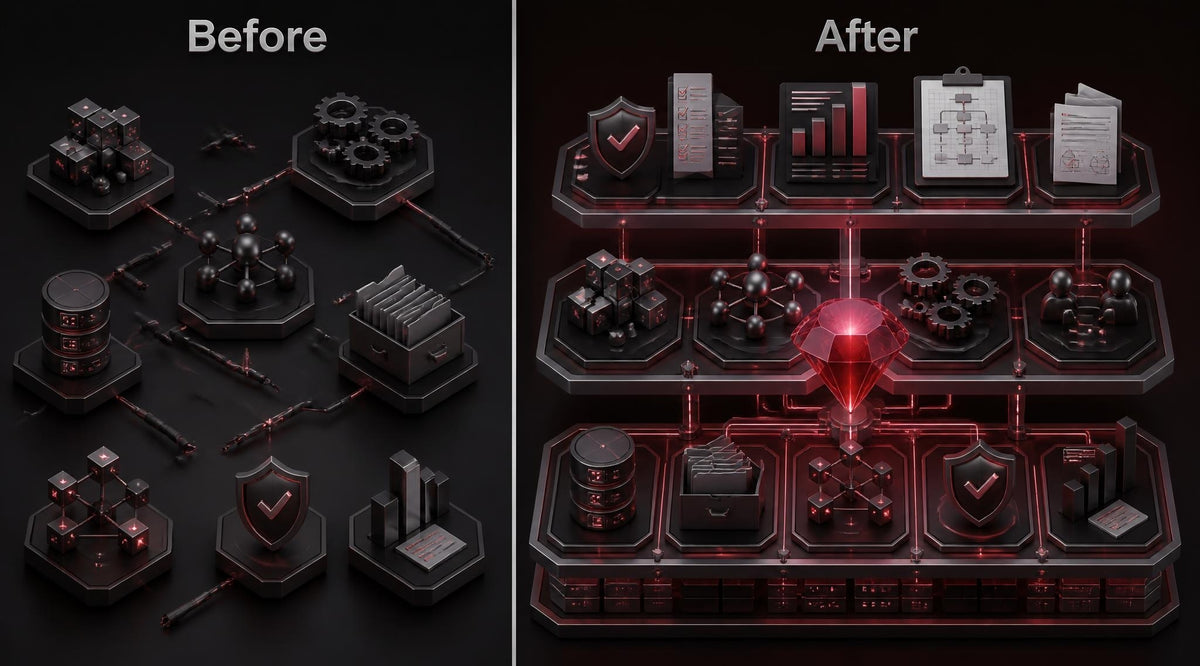
Developing larger Ruby applications requires more than understanding individual programming techniques. Classes, data repositories, workflows, and processing components must interact through clearly defined relationships. Managing these connections introduces challenges involving data consistency, error handling, and application structure. Changes to one component may influence the behavior of other parts of the system. Understanding integrated application design helps developers organize these relationships and evaluate technical decisions.
2. Solution
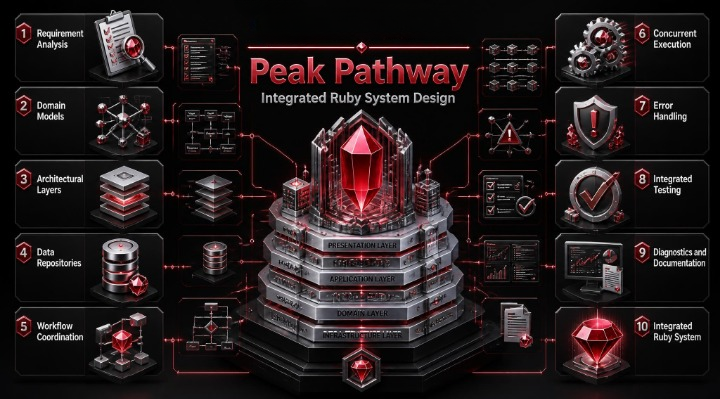
Peak Pathway brings together advanced Ruby programming concepts through ten connected learning modules. Each section combines architectural explanations with practical examples of application components and their interactions. Learners explore domain modeling, data repositories, workflow coordination, concurrent operations, and integrated testing. Guided exercises demonstrate how to organize responsibilities, manage application state, and examine system behavior. The course concludes with a comprehensive Ruby application project combining the technical concepts covered throughout the materials.
3. What's Inside?
Module 1 — System Requirements and Planning
Explore application requirements, technical objectives, component responsibilities, and approaches to organizing development tasks.
Module 2 — Domain Models and Application Structure
Design Ruby classes and domain models that represent application information, operations, and relationships.
Module 3 — Architectural Layers and Components
Examine application layers, service objects, modular boundaries, and communication between programming components.
Module 4 — Data Repositories and Persistence
Organize stored information, develop repository interfaces, and manage data retrieval, updates, and validation.
Module 5 — Workflow Design and Coordination
Explore connected processing operations, task lifecycles, workflow states, and coordination between application services.
Module 6 — Concurrent Operations and Shared Resources
Examine thread coordination, synchronization, shared-state management, and controlled execution of related tasks.
Module 7 — Error Handling and Recovery
Develop approaches to handling invalid operations, interrupted workflows, inconsistent records, and application recovery.
Module 8 — Integrated Application Testing
Explore component testing, integration scenarios, boundary conditions, and verification of interactions between application layers.
Module 9 — Diagnostics and Technical Documentation
Organize diagnostic records, examine system behavior, document component responsibilities, and review architectural decisions.
Module 10 — Integrated Ruby Application Project
Develop a structured Ruby learning workflow system combining domain models, data repositories, service components, task coordination, validation, testing, and diagnostic reporting.
Additional Course Materials
- 27-page downloadable PDF coursebook
- 10 structured learning modules
- Practical Ruby programming examples
- Integrated application architecture diagrams
- Domain modeling and repository exercises
- Service coordination and workflow examples
- Concurrent processing and synchronization activities
- Data validation and error recovery scenarios
- Integrated testing and diagnostic exercises
- Guided practice and review questions
- Comprehensive Ruby application project
- Technical reference material
- Digital Structionix Course Certificate
- Offline reading format
4. Who Is This For?
Peak Pathway is designed for learners with previous experience in Ruby programming, object-oriented concepts, modular architecture, and structured data processing.
The course is suitable for individuals interested in developing connected applications that combine multiple technical components and programming techniques.
It is particularly relevant to learners who want to examine application design decisions, component interactions, workflow coordination, and integrated system testing.
5. What You'll Learn
- Analyze application requirements and technical objectives.
- Design structured Ruby domain models.
- Organize applications into architectural layers.
- Define responsibilities for classes and service components.
- Develop data repositories and persistence operations.
- Coordinate application workflows and task states.
- Manage concurrent operations and shared resources.
- Apply data validation and consistency checks.
- Handle processing errors and interrupted workflows.
- Develop integrated tests for connected components.
- Organize application diagnostics and documentation.
- Evaluate architectural decisions and component relationships.
- Build a complete Ruby application combining multiple programming concepts.
6. Digital Course Certificate
Peak Pathway includes a downloadable Structionix Certificate of Completion in PDF format.
The certificate identifies the course and its educational focus on integrated Ruby systems design, application architecture, data management, workflow coordination, and component testing.
It is issued by Structionix as part of the course materials and does not represent an independently accredited qualification.
7. Refund Information — 30 Days
Refund requests for Peak Pathway may be submitted within 30 days of purchase.
All requests are reviewed according to the Structionix refund policy, including the conditions applicable to downloadable digital course materials.
- 💎 Digital file available after purchase
- ♾️ Long-term availability
- 🛡️ Secure checkout
- 🔄 Content updated in 2026
1. How is the Structionix course collection organized?
1. How is the Structionix course collection organized?
Structionix offers ten Ruby Programming courses arranged from introductory to more advanced topics. Each course includes explanations, code examples, and practical exercises.
2. Is previous programming experience required?
2. Is previous programming experience required?
No experience is needed for introductory courses. Familiarity with Ruby fundamentals is recommended for more advanced materials.
3. How are the learning materials structured?
3. How are the learning materials structured?
Courses are divided into thematic modules featuring explanations, Ruby code examples, and practical exercises for independent study.
Share